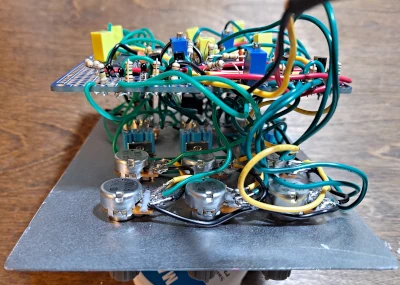
Finished Product
The finished product is contained within these two boxes.
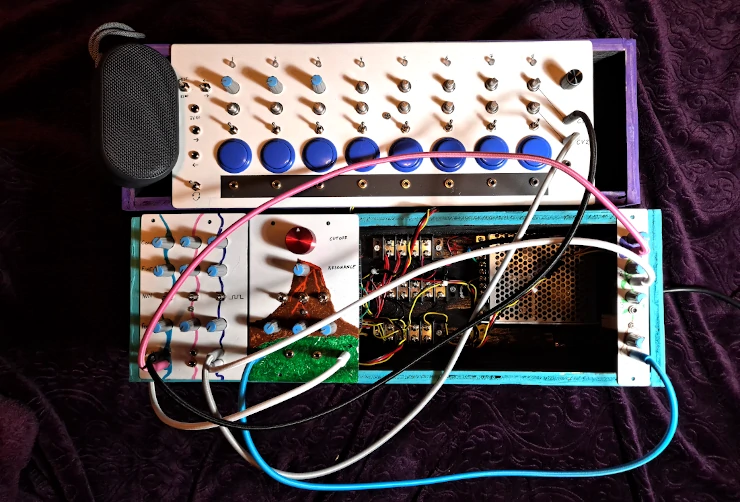
The 8-step dual-VCO sequencer is in the top box while the bottom unit contains a 3-voice VCO, a Diode Filter Ladder unit, and a 3-channel mixer. If none of this made sense, keep reading to see what all is here.
The "Zoog" Standard
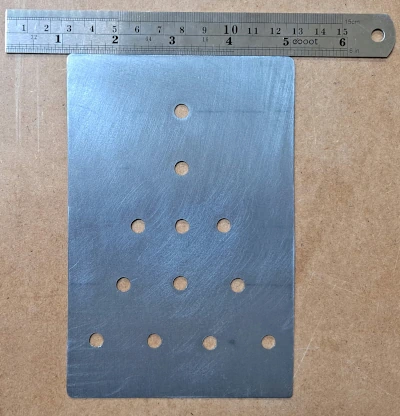
Zoog modules are 6" tall with mounting holes within the top 1/4" from the top and bottom of the modules. Modules widths are increments of 1". Future modules I build will most likely follow the Eurorack standard. All faceplates are 16ga steel.
Modules may accept +12v, GND, and -12v. If the module requires any other voltages a regulator on the module must provide it.
Eurorack Terms
Euroracks are boxes that contain modules. Modules are responsible for everything that a rack does. Modules can create sounds, control other modules, manipulate sounds created by other modules and mix various sounds together.
Modules are all hooked together using mono audio patch cables. Modules have lots of various jacks for different purposes. Most racks have the following:
Audio Signals
Audio signals can be generated by modules or manipulated by modules and are eventually mixed together and sent to a speaker or microphone for recording.
Typically audio signals are around 10 volts "peak-to-peak" meaning that the voltage is centered at 0 volts and fluctuates between -5 volts and +5 volts depending on the waveform.
Control Voltages
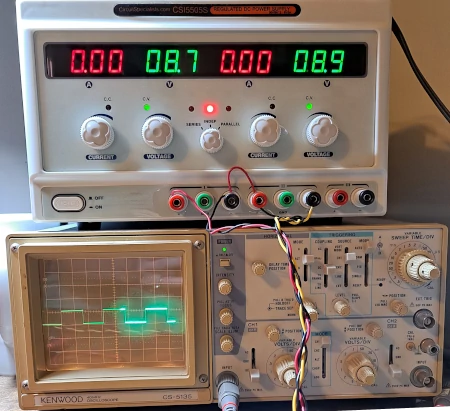
Control Voltages are commonly called "CV"s. These voltages are used to adjust other modules. The most prevalent of these is the frequency of a tone. This is called the "1 volt per octave" standard.
A bass tone is played while the control voltage is "off" at 0v. Any increase of voltage will cause an increase in an oscillator module (which creates a sound) sweeping through all the notes. If the bass note were "A" at 0 CV volts at the max CV level of 5 volts another "A" would be played, five octaves higher.
CVs can also be used to set the level of distortion in a filter, the tempo of a sequencer or nearly anything else you could do with a knob if the module was built to support a CV input.
Modules
I can't take credit for designing any of these modules, they are all derivative works. I've included links for each module to their creators. Modules were built on breadboards first then moved over to stripboards for the final builds.

3:1 Mixer
Deopfer DIY published several mixer schematics at this page. I used the standard CV mixer with only a single output. I used the J6 "Out 2" to ensure the output was inverted twice (to become normalized) since I was using LM384 OP-AMPs.
This module takes in three signals (Audio or CVs) and provides a level adjustment knob for each. These three signals are mixed together and output into a single jack. There is also a main control knob that dictates the level of the mix.
Shapes VCO
This module was created by Moritz Klien. You can find the link here to a wonderful series on the exact operation of this module:
How to build a DIY 3X VCO module from scratch
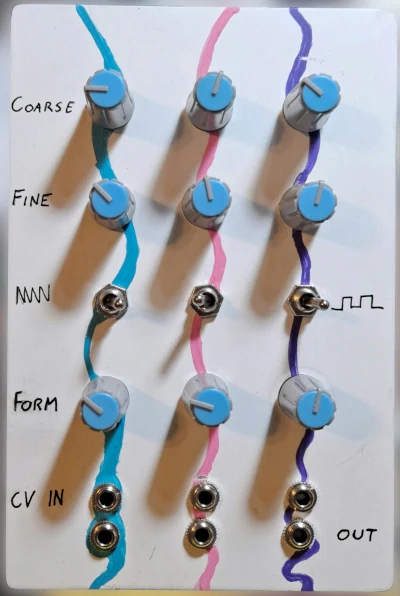
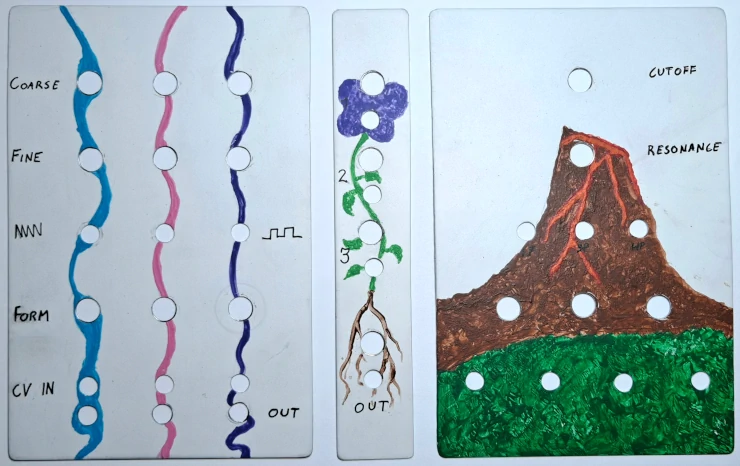
The Shapes Voltage-Controlled Oscillator contains three independent oscillator circuits. Each is capable of generating either a sawtooth or square wave. The square wave can have shaping applied to make it sound more grainy with the "form" control knob.
The root pitch of each oscillator can be set with course or fine-tuning knobs and the overall pitch above the starting pitch can be controlled with a CV.
Diode Ladder Filter
This module was also created by Moritz Klien. He also documented a series around the science in this module here:
Designing a diode ladder from scratch
The Diode Ladder filter uses a resonance circuit to add feedback to an input signal. This results in a fuzzy or sci-fi laser style sound. If the "cutoff" value is changed while a tone plays this can result in really cool effects.
Filter cutoff can be driven by input CVs so the filter can be externally controlled by other modules or sequencers. For example the sequencer could play a C-Major scale and gradually increase the distortion as the notes ascend.
Additionally, there are three filters controlling the signal going into the ladder: A low-pass, band-pass and high-pass filter. These can be used to augment the sound in various ways.
8-Step Dual-CV Sequencer with Keyboard
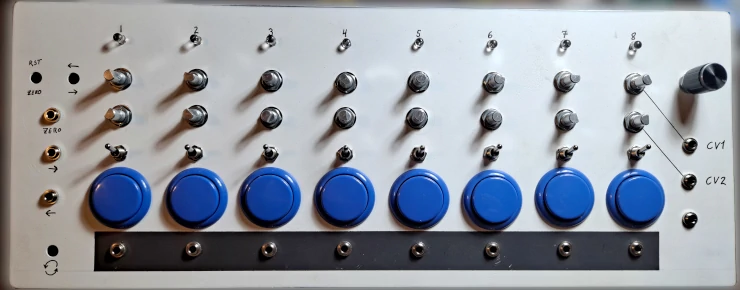
Initially I saw this module from Look Mum No Computer's channel. There's another variation on this module on Analog Output's channel. I wound up using the schematics from Analog Output with my own twist.
My largest modification to this module is the replacement of the fixed-dial switch with a rotary encoder. The encoder supports being pressed for a click. This allows the module to have multiple "scroll modes". Currently there are only two so a press toggles between them:
- Mode 1 - Change Sequencer Pattern (8 Step, 7 Step, Random, etc...)
- Mode 2 - Tempo
Secondly I have added a built-in clock generator in software that can be toggled on and off with a switch on the front panel. The tempo can be set using the second rotary mode.
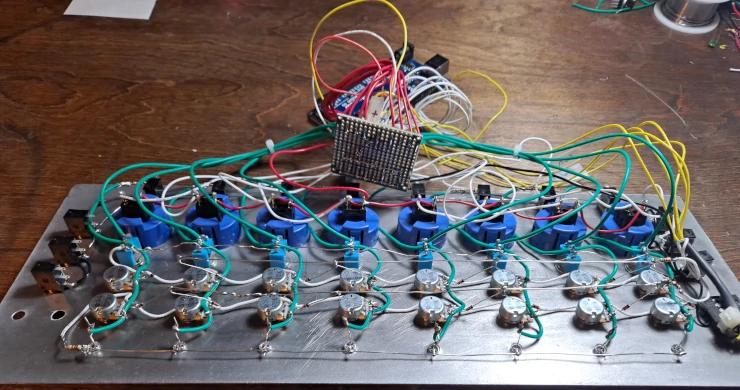
Due to all these changes I found it easiest to rewrite the arduino code from scratch using an Arduino Mega to get more digital pins.
Here's the guts of the module:
Conclusion
I had a blast with this project and learned a ton about analog electronics. Although there aren't too many capabilities with the existing set of modules it's enough to start sounding musical.
I'm very thankful for all the individuals that took the time to share their schematics with the world and for all the enthusiasm they have for analog audio.
Other Pictures
Here's some in-progress pics!
Zoog Faceplate Manufacture
Zoog Faceplates
Module Breadboards
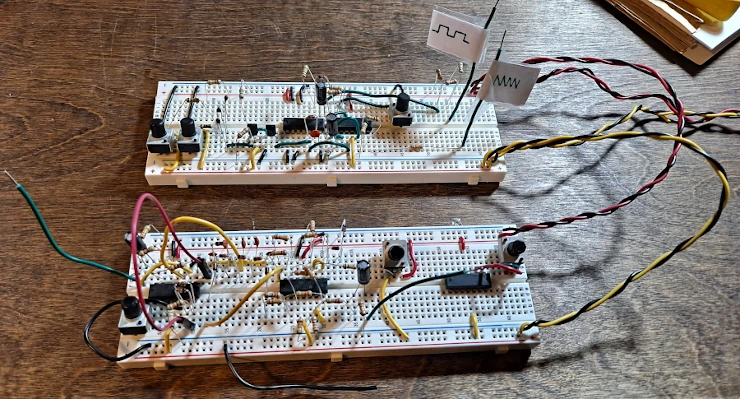
VCO Rear Wiring